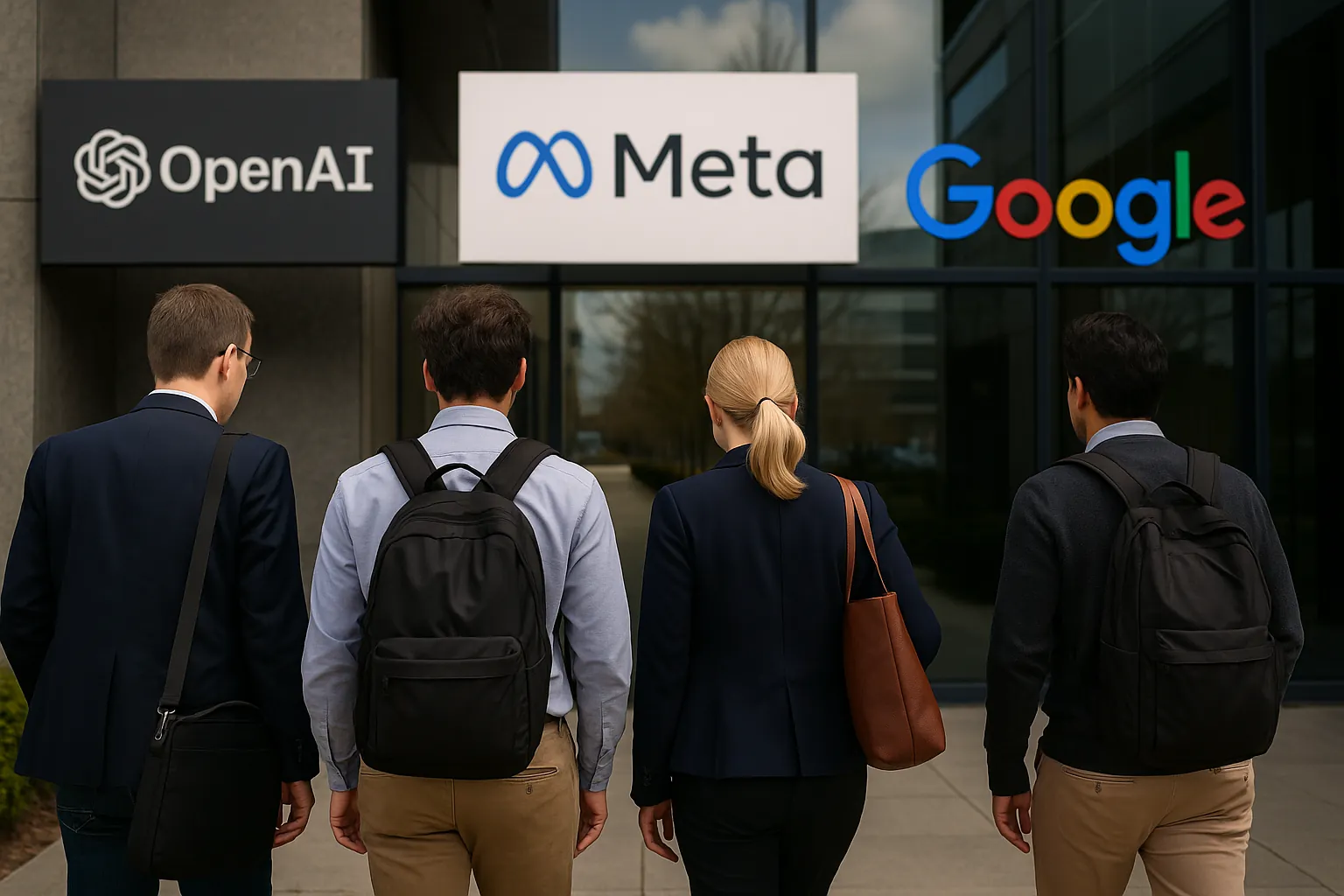
When top AI researchers defect from OpenAI, Google, and Meta, it is not just a career move — it’s a signal flare. The founding of Periodic Labs by William Fedus, co-creator of ChatGPT, and other AI veterans exposes cracks in Big Tech’s monopoly on artificial intelligence. This new venture promises not another chat app, but something more radical: AI systems that accelerate real-world scientific breakthroughs in physics and chemistry.
The story is both about ambition and rebellion. For years, Silicon Valley has been trapped in the race toward “superintelligence.” Yet behind the glossy demos and trillion-dollar valuations, insiders whisper of stagnation, burnout, and wasted billions. Periodic Labs is the counter-move — a rejection of the spectacle in favor of substance.
Context: the mainstream narrative
The New York Times reports that a cohort of high-level AI experts has left OpenAI, Google DeepMind, and Meta to launch a startup aiming to integrate machine learning with experimental sciences. Periodic Labs has secured early venture capital backing, presenting itself as the antidote to overhyped AI hype cycles.
Mainstream coverage frames this exodus as just another entrepreneurial shuffle. They see it as a fresh startup story — brilliant minds taking risks to pursue uncharted frontiers. Investors, dazzled by the buzz, line up to fund the promise of AI-driven scientific discovery.
But the official narrative misses the bigger picture. This is not just about one company. It is about the erosion of Big Tech’s grip on AI talent, and the underlying disillusionment among the very researchers who built the industry’s flagship products.
Oppositional Argument: why the mainstream is wrong
The coverage hails Periodic Labs as a “natural evolution.” In reality, the fact that top AI researchers defect from trillion-dollar companies reveals something more damning: Big Tech’s AI projects are stagnating.
Insiders at OpenAI whisper of chaotic leadership and safety concerns buried under investor demands. Google’s DeepMind has been absorbed into Alphabet’s corporate machinery, suffocating its scientific spirit. Meta continues to bleed money on metaverse fantasies, forcing AI divisions to pivot endlessly.
By leaving, these researchers are voting with their feet. They are declaring that the endless chase for “artificial general intelligence” has become an empty marketing slogan. Instead, they want AI to be useful — to push chemistry forward, to design new materials, to solve real problems.
Analytical Breakdown: causes and consequences
Why does this matter?
First, the talent drain is undeniable. For years, OpenAI and Google DeepMind hoarded AI talent with massive salaries and stock packages. Now, cracks are appearing. If even a handful of high-level researchers defect, it encourages others to question their loyalty. Talent wars will intensify, with startups offering intellectual freedom over corporate perks.
Second, the research agenda is shifting. Instead of theoretical papers about scaling large language models, Periodic Labs wants AI integrated directly into labs — running experiments, modeling molecules, predicting chemical reactions. This is not science-fiction; it is the kind of work that could transform drug discovery or clean energy.
Third, the funding climate is tilting. Investors are weary of pouring billions into chatbot wars that generate little revenue. A lab promising concrete applications in physics and chemistry is easier to pitch: new drugs, stronger materials, cleaner batteries. These outcomes translate directly into markets.
Finally, the political undertones are real. While governments panic about AI safety and existential risks, researchers are quietly admitting that the real challenge is more mundane: making AI actually useful. By reframing AI as a tool for discovery, Periodic Labs undermines both Big Tech’s hype machine and Washington’s fearmongering.
Human Perspective: breaking free from the machine
Consider the testimony of one anonymous researcher who left DeepMind: “We were optimizing benchmarks that no one outside the lab cared about. I wanted to build something my grandmother could understand — a medicine, a new material. Not another leaderboard.”
That sentiment resonates across the AI field. While ChatGPT dazzles headlines, inside the labs morale is shaky. Engineers complain about being reduced to “model janitors,” endlessly tweaking parameters to make flawed systems behave. Periodic Labs offers them something different: freedom to tackle science itself, not just the next product demo.
Ordinary people, too, have a stake. Imagine AI that accelerates cancer drug research or enables cheaper solar panels. For the average citizen, this is far more meaningful than another chatbot spewing marketing copy. Periodic Labs’ vision reconnects AI to human progress — not shareholder spectacle.
Counterarguments
Skeptics argue that defectors overestimate their ability to outpace Big Tech. Google and OpenAI command data, infrastructure, and capital on a scale no startup can match. Without access to massive compute, Periodic Labs may find itself quickly irrelevant.
But this critique misses the point. Periodic Labs is not trying to beat OpenAI at chatbot scale. It is trying to carve out a different niche — one where smaller models, tuned to scientific tasks, outperform bloated general-purpose systems. In this context, agility and focus matter more than brute force.
Conclusion: a rebellion worth watching
The exodus of top AI researchers from Big Tech to Periodic Labs is not a footnote. It is a rebellion. It is proof that even those who built the current AI juggernauts see its limits. By betting on science rather than spectacle, these researchers are gambling that the next breakthroughs will come not from trillion-parameter models, but from AI embedded in real-world discovery.
Whether Periodic Labs succeeds or fails, its mere existence tells us something profound: Big Tech’s monopoly on AI innovation is crumbling. The people who once powered its rise are now walking away. That, more than any hype about superintelligence, may shape the future of artificial intelligence.