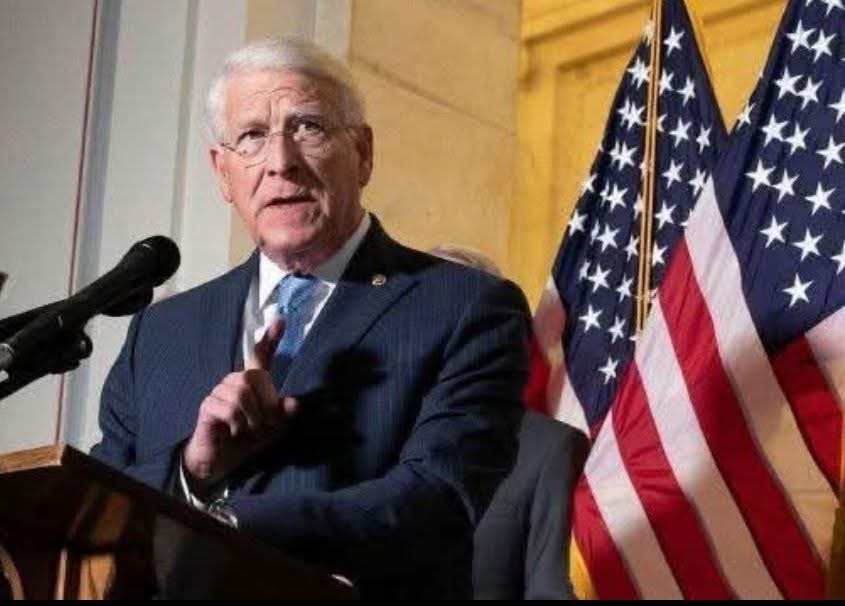
For days Washington drowned in confusion — mixed messages, contradictory statements, and timid attempts to rebrand Moscow’s wish list as a “peace plan.” Then suddenly, a voice broke through the noise. Not a junior lawmaker hungry for attention. Not a commentator shouting into a void. But Senator Roger Wicker, the Republican chairman of the Senate Armed Services Committee — a man whose words carry weight in every room where American national security is discussed.
And what he said was not diplomacy.
It was a demolition.
Wicker did what others in Trump’s orbit refused to do: he called the 28-point “peace plan” exactly what it is — a blueprint for Ukraine’s capitulation and an invitation for future wars.
His intervention was more than criticism; it was a political strike that exposed the dangerous logic behind Trump’s new foreign-policy experiment.
A Senator Who Refused to Play Along
Wicker did not soften the message.
He did not hide behind vague formulations.
He said the quiet part out loud:
- “Forcing Ukraine to give land to Putin’s butcher is absurd.”
- “Only Ukraine decides the size and deployment of its army.”
- “Concessions to dictators are not compromises — they are rewards for aggression.”
These words were not crafted for cable news. They were a warning to the White House: the U.S. Senate will not rubber-stamp a deal that hands Putin strategic victories he could never achieve on the battlefield.
Wicker effectively told Trump what his advisers are afraid to say:
you cannot negotiate with a predator by feeding him someone else’s territory.
The 28-Point Plan: A Trap Disguised as “Peace”
Behind Trump, Vitkoff, Vance and other intermediaries stands a simple political calculation: sell the American public a quick “peace,” declare victory, and hope no one asks what happens next.
Wicker dismantled that illusion in one sentence.
By freezing Ukraine’s sovereignty, limiting its military, and handing Russia territorial gains, the plan does not end the war — it pauses it until Putin is ready for the next one.
This is the fundamental truth Trump’s team refuses to acknowledge.
And it’s the truth Wicker put on the table.
Why the Capitulation Narrative Is Dangerous for America
The US Senate Ukraine capitulation debate isn’t about Ukraine alone. It’s about American security, credibility, and the future of global order. Wicker’s argument touches the nerve that Trump’s administration tries to avoid: concessions to the Kremlin weaken the United States.
If Putin gets even a fragment of Ukrainian territory under the guise of a negotiated “peace,” then:
- aggression becomes a legitimate negotiation method
- U.S. commitments become unenforceable
- NATO allies begin doubting American guarantees
- China takes notes
- every authoritarian regime sees weakness, not strategy
Wicker said what sober strategists know:
if the U.S. rewards territorial conquest, it dismantles its own deterrence architecture.
Appeasing a Tyrant Never Leads to Stability
The Senate finally remembered its history.
Munich 1938.
Obama’s “red line” in Syria.
Georgia 2008.
Ukraine 2014.
Each moment of Western hesitation became a stepping stone to something worse.
Wicker articulated the pattern:
Tyrants do not stop when they are offered compromise.
They stop when they are stopped.
Trump’s 28-point plan ignores that principle completely. It treats Putin as a rational negotiator rather than a revisionist dictator who has built his political legacy on war, coercion, and imperial nostalgia.
Even Republicans Are Losing Patience
Wicker is not a fringe figure.
He is a senior Republican with decades of experience.
His rejection signals a shift inside the GOP.
Behind closed doors, many Republicans are tired of pretending that “Russian demands” equal “peace.” The reaction to Wicker’s statement shows that even within Trump’s own party, patience with Kremlin-friendly narratives is wearing thin.
This is why the plan is collapsing:
- it cannot pass the Senate
- it is losing support among key Republicans
- the national security establishment sees it as a threat
- U.S. allies reject it outright
The US Senate Ukraine capitulation debate is no longer a theoretical dispute — it is a political fracture line.
Trump’s Team Miscalculated
Wicker’s statement exposed a depth of opposition the White House clearly did not anticipate. Trump’s advisers assumed that presenting a “peace plan” wrapped in patriotic language would neutralize criticism. Instead, the Senate treated it as a Trojan horse.
Wicker’s critique is not directed at Ukraine; it is directed squarely at the strategic naïveté of Trump’s approach.
He reminded Washington of the stakes:
U.S. interests collapse when authoritarian ultimatums are dressed as diplomacy.
Putin’s Ambition Doesn’t End in Ukraine
Wicker highlighted the nightmare scenario Trump prefers to ignore:
the territory Putin demands today from Ukraine is the pressure he will apply tomorrow to the Baltics, Poland, or even NATO military presence.
Satisfying a dictator’s first appetite ensures there will be a second — and a third.
It is not a theory. It is the entire history of the last 20 years.
Wicker’s message:
capitulation is not peace; it is preparation for the next invasion.
A Necessary Warning to the West
Europe and the U.S. spent two years pretending that the war would resolve itself. It didn’t. It escalated. Every compromise pushed Russia forward. Every hesitation expanded the battlefield.
Wicker’s intervention is the first real signal that American leadership is willing to confront that reality. It is a reminder to the West that values mean nothing without backbone.
He said openly what others whisper:
the only peace Putin respects is the peace he fears to violate.
The Shift Has Started
After Wicker’s remarks, everything changed:
- the Trump-Vitkoff-Vance plan no longer looks viable
- the Senate is drawing a red line Trump did not expect
- the Kremlin received an unwelcome message
- Kyiv gained an ally where it mattered most
This is the moment the debate stopped being theoretical. Wicker forced Washington to choose between illusion and strategy.
Conclusion: The Senate Just Drew the Line Trump Wouldn’t
Wicker’s intervention is more than political drama.
It is a strategic correction.
He dismissed the Kremlin-approved “peace plan” as what it is — an engineered surrender. He reminded the U.S. that appeasing a tyrant endangers not only Ukraine but the entire Western security system. And he forced the White House to confront a simple truth: authoritarian demands are not diplomacy — they are a test.
For the first time in months, the Senate delivered clarity:
tyrants don’t stop when offered concessions;
they stop when confronted.
External Links
- https://www.congress.gov
- https://www.nato.int