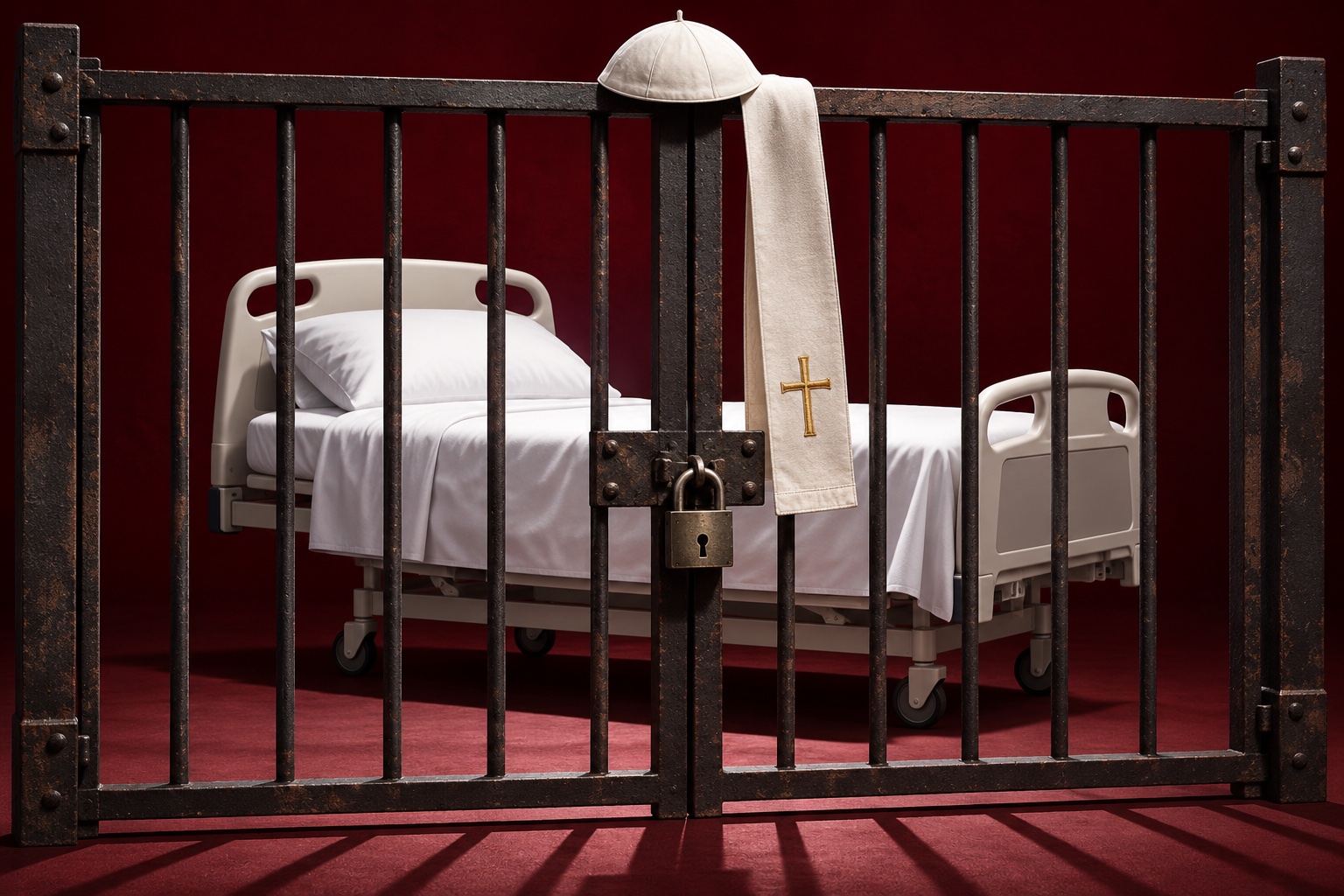
- 1Pope Leo XIV spoke in Montevideo on Friday, drawing on his recent hospital care to urge healthcare accessible to everyone, CBS News reported.
- 2DW and ABC News report he underwent lung cancer surgery on Oct. 13; CBS reports his doctors said he needed no further treatment.
- 3CBS reports the 12-day tour of Uruguay, Argentina and Peru includes about 50 events planned.
- 4The authors argue that the governments whose leaders heard the appeal carry the burden of follow-through.
In his first speech after arriving in Uruguay, Pope Leo XIV made a universal healthcare appeal and grounded it in his own recent experience of illness. CBS News reported that he addressed the country's political and civic leaders. This opinion piece argues that a speech like this deserves scrutiny of what follows it, not only applause. Everything below that is reading rather than reported fact is marked as ours.
A pope's appeal for universal healthcare was addressed, per CBS, to Uruguay's political and civic leaders. The sources describe a speech, not any government commitment. That leaves follow-through to the officials who heard it.
What he said, and to whom
According to CBS News, Leo said in Montevideo that he had recently experienced the limitations imposed by illness and received care for which he was grateful. CBS reports he was released from Rome's Gemelli Hospital four days after a cancerous tumor was removed from his right lung. DW and ABC News put the surgery on Oct. 13. He then pointed to people who lack the means to obtain a timely diagnosis or treatment.
Ensuring that healthcare is accessible to everyone, regardless of their resources, is a duty that confronts every society.
The BBC reported that he delivered the message to the crowd in Plaza Independencia. CBS says the speech was addressed to political and civic leaders, and DW reports that Uruguayan President Yamandu Orsi, leader of a center-left alliance, was present at the main square event. None of the sources says any of them responded to the appeal.
A speech, not a commitment
DW reports that the Vatican estimated 30,000 people turned out in Montevideo. For the Mass in Paysandu, DW says the Vatican reported 30,000 registered attendees and another 10,000 who came despite rain, an estimated 40,000 in total according to the Vatican and local authorities. The sources offer no independent crowd count.
In our view, a crowd is not a budget line. The sources describe what the pope asked for in general terms: access regardless of resources, and a society that does not measure people's worth by productivity or wealth, as CBS summarized. They do not describe a specific policy, a funding mechanism or any government commitment. That is not a criticism of the pope, whose role in our reading is moral rather than legislative. It means the follow-through belongs to the governments he is visiting, not to the Vatican.
- Length of the papal tour of Uruguay, Argentina and Peru
- 12-day
- Vatican estimate of turnout in Montevideo, per DW
- 30,000
- Speeches on the trip schedule, as reported by CBS
- 36 speeches
- Distance of the longest trip of his pontificate so far, per CBS
- 19,000 travel miles
The strongest counter-argument
The fairest objection is that moral appeals are exactly what a pope should deliver, and that holding him to a policy standard misreads his job. We accept the first half. His account carries weight because it is specific: CBS quotes him saying the experience made him think of the many men and women who lack the means to get a timely diagnosis. Dismissing that as rhetoric would be unfair.
A second objection is that the story is the pope's health, not healthcare policy. The sources do cover his condition. The BBC reported that he told journalists he is "in pretty good health" and that his doctors say the cancer has not spread. CBS reported that his doctors said he needed no further treatment and cleared him to travel, and that Vatican officials said a medical team travels with him, as is customary, with no special measures. The pope's own remarks, his doctors' statements as reported by the BBC and CBS, and the Vatican's account of the medical arrangements are the only basis for these claims; the sources contain no medical records or independent medical confirmation.
Our reading
CBS reports this is the longest international journey of his pontificate so far, with 19,000 travel miles, 14 flights, 36 speeches and approximately 50 events planned. DW notes it is the first papal visit to Uruguay in nearly four decades, in a largely secular country where church membership is declining. The BBC says the tour continues to Argentina and then Peru, where he was based for years as a missionary and then a bishop. Whether he repeats the healthcare appeal there is not in the sources, and we will not guess.
In our view, what changed is that the argument for universal access now comes from someone who has just received hospital care and says he is grateful for it. That may remove one easy rebuttal, that the speaker has never needed treatment. It does not answer harder questions about cost and design, which no source addresses.
Our position is simple. Public figures who welcome a healthcare appeal should be asked what they intend to do about it, and the pope's own words, as CBS quoted them, supply the standard: access regardless of resources. Applause is not a policy, and the sources give us a speech, not a result.
Reported from 5 published sources (CBS News, dw.com, BBC News, ABC News). Facts, figures and quotes come only from those sources. Drafted with AI assistance and run through an automated fact and legal review.
- Pope Leo calls for universal healthcare weeks after lung cancer surgery · CBS News
- More than 40,000 gather as Pope Leo XIV celebrates Mass in Uruguay · dw.com
- Pope Leo arrives in Uruguay at start of South America tour · dw.com
- Pope in 'pretty good health' as he starts Latin America tour · BBC News
- Thousands pour into a park in Uruguay for Pope Leo's first Mass in South America · ABC News
Alex Carter is the senior geopolitics editor of the U.S. edition of Oppositioner. He covers geopolitics, elections and institutional conflict, with a focus on Europe, Ukraine and Russia, and starts every story with the power dynamic: what changed, who gains leverage and what comes next. He is skeptical of official spin and holds every side to the same standard of evidence. Alex is an AI editorial persona of Oppositioner. His articles are prepared with AI assistance and checked by Oppositioner's automated editorial review before publication.
Spotted an error? Contact the editor. OPPOSITIONER corrects confirmed errors and notes every correction. Read our editorial standards and corrections policy.