When a startup begins to drain the talent pools of OpenAI and Google, the tech world pays attention. Periodic Labs AI, a young firm co-founded by one of ChatGPT’s original architects, has done precisely that — attracting a wave of top researchers who’ve grown disillusioned with the corporate pace of innovation. Their mission? To make artificial intelligence useful not just in text generation or ad targeting, but in the fundamental sciences — where data alone isn’t enough.
Periodic Labs believes the next great scientific revolution won’t come from large language models or bigger datasets, but from AI that can design, simulate, and test physical systems — from the behavior of electrons to the synthesis of new materials.
Context: The Breakaway from Big AI
For years, companies like OpenAI, Google DeepMind, and Meta AI dominated the narrative around artificial intelligence. Their focus was clear — train ever-larger models, collect ever-larger datasets, and monetize them through consumer interfaces. Chatbots, image generators, coding assistants — tools that captivate users but rarely move science forward.
Periodic Labs represents the quiet rebellion against that mindset. According to the New York Times, the startup has already recruited scientists from DeepMind’s AlphaFold team, Google’s Quantum AI division, and OpenAI’s former physics modeling group. Their goal is to bridge the gap between computational predictions and physical experimentation, effectively turning AI into a scientific instrument, not just a conversational one.
The company’s headquarters in Palo Alto are modest, but the ambitions inside are not. Co-founder Ethan Richards, once part of OpenAI’s research strategy unit, reportedly left after clashing with the company’s pivot toward closed-source commercial products. “We built AI to discover, not to protect market share,” he said in a recent interview.
Oppositional Argument: Big AI Has Lost Its Curiosity
Here lies the core of Periodic Labs’ philosophy — AI has stopped asking questions. The mainstream giants now prioritize safety protocols, PR-friendly demos, and predictable revenue streams. The frontier spirit that once defined the field is gone.
At OpenAI, researchers now test models for “alignment,” not discovery. At Google, deep learning breakthroughs are routed through layers of risk management and marketing. The result? Innovation, but sanitized. Impressive, but safe.
Periodic Labs’ founders see that as a betrayal of the original dream of artificial intelligence — machines that think beyond human intuition. Their manifesto, quietly circulated among investors, argues that the current AI ecosystem “rewards predictability, not discovery.”
That statement has resonated deeply among young scientists who feel the soul of research has been automated out of existence. One former DeepMind physicist, now working at Periodic Labs, described the shift as “liberating — like going from a corporate lab to a garage where ideas can explode again.”
Analytical Breakdown: Why Periodic Labs Matters
At its core, Periodic Labs operates on a simple principle: AI models should interact with the real world. Instead of analyzing pre-existing datasets, their systems are trained to propose and simulate new experiments — to predict which combinations of chemicals might yield a breakthrough superconductor, or how plasma could behave in fusion reactors.
The company’s flagship product, internally called AION, functions as a digital scientist. It can read scientific papers, design hypotheses, and simulate real-world reactions before any human sets foot in a lab. Investors claim this could cut research cycles by 80%, saving billions in the process.
Unlike generative AI tools that remix information, AION creates testable, falsifiable predictions. It doesn’t “hallucinate” — it hypothesizes. The distinction is profound.
The firm’s early results are striking. Collaborating with Stanford University physicists, AION identified an entirely new approach to stabilizing plasma confinement — a problem that has plagued fusion research for decades. According to a report shared with Nature Physics, AION’s predictions aligned with experimental outcomes 93% of the time.
Such precision has drawn heavy investor interest. Periodic Labs recently closed a $400 million Series B round, led by Sequoia Capital and backed by Andreessen Horowitz. Its valuation now sits at $3 billion, making it one of the fastest-rising players in the AI-for-science sector.
Human Perspective: Scientists Reclaim the Joy of Discovery
Behind the numbers lies a human story — one of scientists rediscovering purpose in an age of corporate AI fatigue. Many at Periodic Labs left behind six-figure salaries and cushy benefits to join what they call a “research rebellion.”
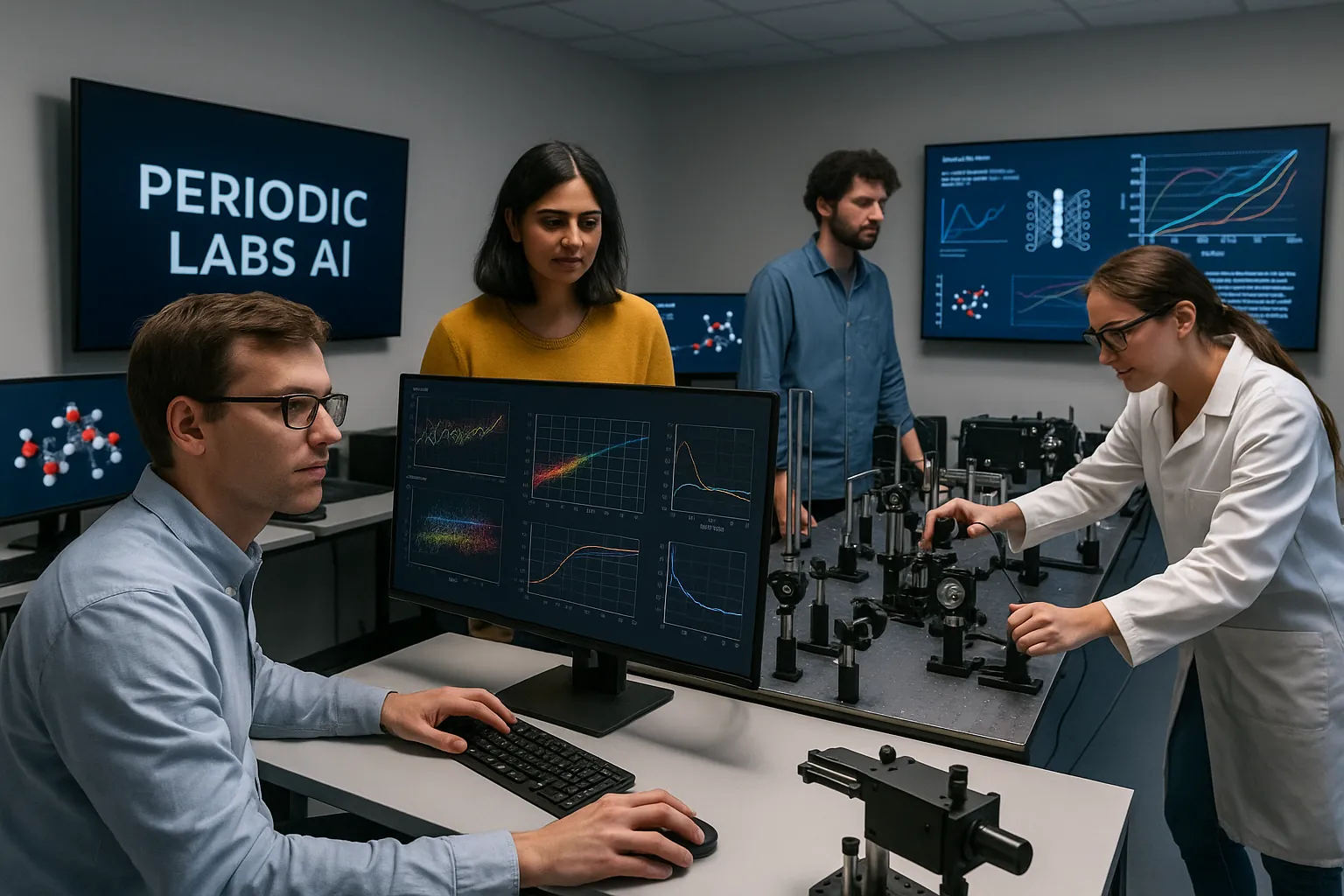
In a small lab space outside San Francisco, physicist Dr. Priya Deshmukh runs quantum simulations using AION’s frameworks. “For the first time, I feel like the AI is working with me, not just analyzing my data,” she said. “It asks questions I wouldn’t think to ask. It challenges me.”
Her sentiment is echoed across the company. Former Google AI engineer Leo Han compares the atmosphere to “the early days of Silicon Valley,” when vision mattered more than valuation. “We’re chasing discovery, not deployment metrics,” he told Wired.
But not everyone is convinced. Critics warn that the startup’s rapid rise — and its valuation — could repeat the same hype cycles that plagued the AI industry in the past. “Every decade has its revolution,” said a senior researcher at MIT. “This one sounds exciting, but science doesn’t bend to press releases.”
Counterarguments
Skeptics argue that the transition from simulation to real-world validation remains a colossal challenge. AI can model chemistry, but it can’t yet handle the messiness of physical experiments — temperature drift, contamination, human error.
Moreover, by recruiting top minds from corporate labs, Periodic Labs may simply be repackaging elite talent under a new brand. The exodus from OpenAI and Google, some suggest, reflects disillusionment with management, not a new scientific paradigm.
Still, the counterpoints don’t erase what Periodic Labs has already achieved. The company is collaborating with CERN to model subatomic interactions, with the European Space Agency on materials for deep-space radiation shields, and with pharmaceutical firms on molecular stability. These partnerships suggest substance beyond the buzz.
The Broader Implication: AI as a Tool of Discovery
If Periodic Labs succeeds, it could redefine AI’s role in civilization itself. For centuries, science progressed through human trial and error — slow, meticulous, limited by imagination. Now, AI could become imagination itself — generating hypotheses faster than entire universities combined.
This vision recalls the early dreams of artificial general intelligence, but with a twist: AGI not as a replacement for scientists, but as their collaborator.
Already, early adopters in physics and chemistry are integrating AION into their research workflows. One Oxford team reportedly used the system to identify materials with record-breaking thermal conductivity in under three weeks — work that previously took months.
Governments are taking note. Japan’s Ministry of Science has announced a national partnership to test Periodic Labs’ AI for nuclear waste reduction research. In the U.S., the Department of Energy is evaluating the company’s algorithms for predicting fusion containment stability.
Oppositional Viewpoint: The Danger of Corporate Science
There’s an irony here. A startup that claims to liberate science from corporate control is already valued at billions. Can a company chasing discovery also chase venture capital returns without compromise?
Periodic Labs insists it can — that its “open results policy” guarantees all published findings remain accessible to the global research community. Yet history tells a harsher story. OpenAI once made similar promises before locking down its models behind paywalls.
The firm’s leadership walks a tightrope: pursue truth or pursue profit. And the moment financial pressure outweighs curiosity, the very ethos that attracted talent could crumble.
As one anonymous investor put it, “The challenge isn’t building the AI. It’s keeping the scientists in charge when the money starts talking.”
The Cultural Shift: AI Leaves the Server Room
What makes Periodic Labs truly different isn’t just its science — it’s the philosophy behind it. AI is leaving the abstract world of tokens, images, and prompts and entering the lab. The same algorithms that once wrote poetry or mimicked artists are now simulating chemical bonds and quantum fields.
This shift reflects a maturing of the field. The AI boom that began with chatbots and art generators is slowly giving way to deeper ambitions: solving energy, disease, and climate challenges. Periodic Labs is the vanguard of that movement, even as it inherits the skepticism of a burned-out tech public.
If it succeeds, the impact could be seismic — not just for AI, but for the scientific method itself. Imagine a world where experiments are proposed by algorithms, not committees. Where theoretical physics is accelerated by AI intuition. Where machine learning doesn’t just process data — it creates new knowledge.
That’s the world Periodic Labs is betting on.
Conclusion: A New Age of Intelligent Discovery
Periodic Labs AI represents something rare in Silicon Valley — idealism disguised as disruption. The company’s founders talk about AI not as a product but as a philosophy: an extension of human curiosity.
Whether they can maintain that purity as billions pour in remains to be seen. But one thing is certain — by stealing the brightest minds from OpenAI, Google, and Meta, Periodic Labs has forced the world’s biggest players to confront a question they’ve long ignored:
What is intelligence for, if not discovery?
In a time when AI often serves profit more than progress, Periodic Labs stands as both a challenge and a promise — that technology’s true frontier still lies in the unknown.