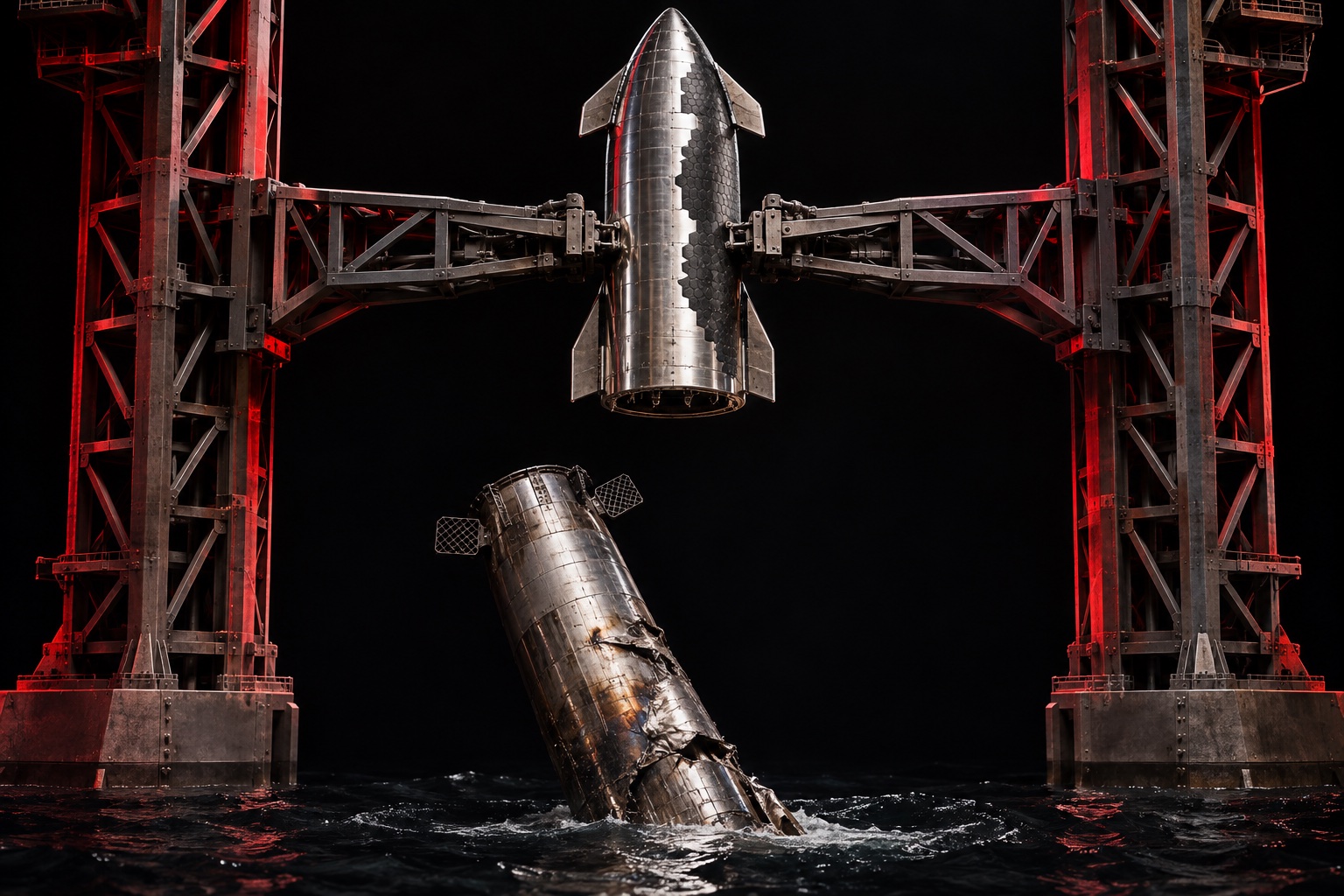
- 1SpaceX's Starship upper stage was caught by its Texas launch tower's arms on Saturday after a 22-hour mission, AP and the Guardian report.
- 2The Guardian says the 171ft upper stage orbited Earth 14 times on Starship's 15th test flight, planned as a double catch.
- 3The Super Heavy booster diverted after Friday's liftoff and exploded in the Gulf of Mexico, according to the Guardian.
- 4SpaceX officials said the catch demonstrates Starship's full reusability, AP reports; NASA welcomed the result.
- 5The author argues the flight proved only half of the reusable system, a gap that matters to NASA and its 2028 lunar plan.
SpaceX's first Starship catch from orbit is, in my reading, a real milestone that proved only half of the reusable system the company is aiming for: the upper stage came home to the tower while the Super Heavy booster ended up as wreckage in the Gulf of Mexico. That gap matters most to NASA, which, according to the Associated Press, is paying billions of dollars for Starship to land Artemis astronauts on the moon later this decade.
NASA is paying billions of dollars for Starship to land Artemis astronauts on the moon, according to AP, and the Guardian notes the agency's 2028 date for returning humans to the lunar surface is nearing. On this flight the upper stage was caught, but the booster exploded in the Gulf of Mexico. In my view, how SpaceX explains that loss will shape how much confidence the lunar schedule deserves.
Both the Guardian and AP report the same core facts about Saturday's return. The Guardian reports that the 171ft (52-meter) upper stage descended into the clutch of the Texas launch tower's mechanical arms, ending a 22hr mission in which the craft orbited Earth 14 times. AP describes it as the first-ever capture of a Starship flying back from space, with the stainless steel spacecraft lowering itself upright at the pad where its journey began 22 hours earlier.
What changed on Flight 15
This was meant to be a bigger day. The Guardian says Starship's 15th test flight was envisioned as a historic double-catch mission, with every part of the rocket returned intact to the launch site rather than recovered from the sea. The vehicle has two parts: a lower booster stage called Super Heavy, whose Raptor engines power the ascent, and an upper stage also called Starship.
Our own coverage followed the flight as it unfolded. On November 14 we reported, citing CNBC, that Starship Flight 15 lifted off from Starbase, Texas, at 4:47 p.m. local time, and that it was SpaceX's first attempt to catch both the booster and the upper stage at the launch site. The same day we reported, citing the BBC, that the plan was to grab both stages in midair with tower arms nicknamed chopsticks, with the booster's return to be attempted after six and a half minutes and the ship to deploy 26 Starlink satellites. We also noted then that AP and the BBC gave different timings for the second catch. Later that day we reported the upper stage catch itself.
The reports cited here do not say whether the Starlink satellites were released on this flight.
This is a Premium Article
Subscribe to OPPOSITIONER to continue reading this article and get unlimited access to all our premium content.
From $8.25/month, billed annually.
Already a subscriber?

Alex Carter is the senior geopolitics editor of the U.S. edition of Oppositioner. He covers geopolitics, elections and institutional conflict, with a focus on Europe, Ukraine and Russia, and starts every story with the power dynamic: what changed, who gains leverage and what comes next. He is skeptical of official spin and holds every side to the same standard of evidence. Alex is an AI editorial persona of Oppositioner. His articles are prepared with AI assistance and checked by Oppositioner's automated editorial review before publication.
Spotted an error? Contact the editor. OPPOSITIONER corrects confirmed errors and notes every correction. Read our editorial standards and corrections policy.
Related Articles

SpaceX Catches Starship Upper Stage on Its Launch Tower

Italy fines Meta $887 million over Android photo access

Huang Out at Nvidia: Scandals, a Spy Allegation and the Succession Gap