Who Gave You the Right
Start with the simple question anyone carrying this idea to the table should have asked themselves: who are you to decide this?
Ukraine's constitution is blunt. Article 2: the territory of Ukraine within its existing border is indivisible and inviolable. Article 73: questions of altering the territory of Ukraine are resolved exclusively by a nationwide referendum. Article 133 names the Donetsk and Luhansk regions as parts of Ukraine. Article 157 forbids any amendment that would violate territorial integrity, and forbids amending the constitution at all under martial law.
Nowhere does that list say "or at the suggestion of American negotiators on the eve of a meeting in Abu Dhabi." It does not say that, and it never will. Ukrainians decide Ukraine's borders. Not the White House, not the Kremlin, and not their lawyers working together.
A Friend Trading Someone Else's Land
The most outrageous part is not Moscow. Nobody expects anything from Moscow but lies and missiles. The outrageous part is Washington.
In the 1994 Budapest Memorandum, the United States committed to respect Ukraine's independence, sovereignty and existing borders. In return Ukraine gave up the world's third-largest nuclear arsenal. Zelensky made the point on November 10: Ukraine renounced nuclear weapons, and Russia then occupied its land (UA.NEWS). In 2014 the UN General Assembly affirmed Ukraine's territorial integrity within its internationally recognized borders, and in 2022 it condemned the "annexation" of four Ukrainian regions. The United States voted yes both times.
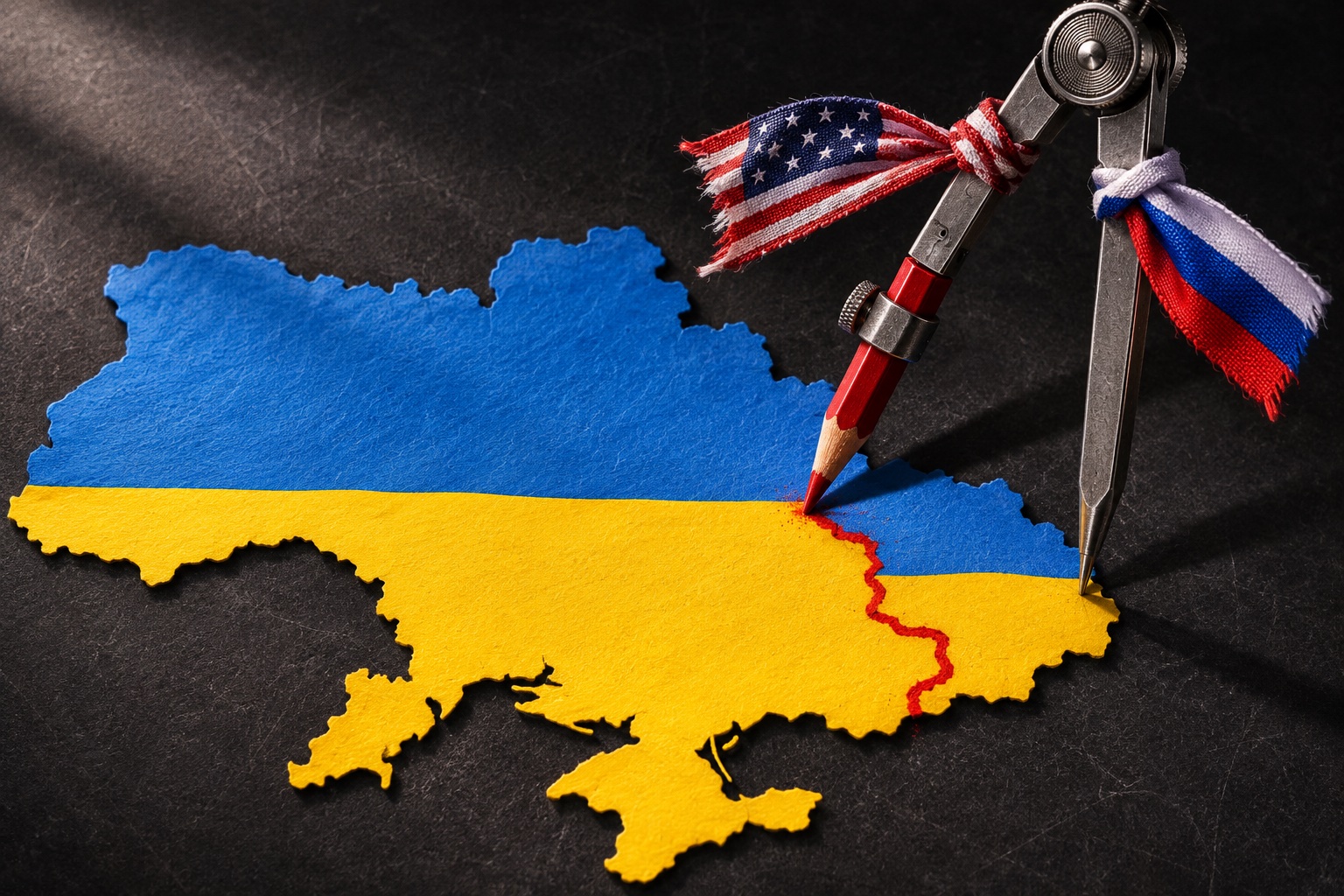
Now the same country that signed up to "existing borders" brings to the table an idea for moving those borders to suit the aggressor. That is not neutral mediation. It is playing on the attacker's side with someone else's land and someone else's lives. When a partner stops pressuring the aggressor and starts looking for ways to sweeten the victim's capitulation, it is no longer a mediator. It becomes an accomplice to humiliation.
The Economist's reporting also explains the rush: after Trump's defeat in the midterm elections, Democrats take control of both chambers of Congress in January (Hromadske). In our view, that is the answer to why this is being pushed so hard: the administration wants a deal closed while it still controls who signs it. Washington will not be the one paying for that haste.
Who Gets the Victory
Remember who exactly is being offered a "cartographic victory."
In March 2023 the International Criminal Court issued an arrest warrant for Vladimir Putin over the unlawful deportation of Ukrainian children. In November 2022 the European Parliament declared Russia a state sponsor of terrorism. Bucha, Mariupol, deported children, thousands of names known from obituaries and casualty lists. The man responsible for this war is not a leader with "legitimate security interests." He is a war criminal with an arrest warrant, and the state he runs terrorizes civilians.
Offering that man a redrawn map as a prize tells every dictator on earth: invade, kill, hold on long enough, and someone will draw the borders to your specifications.
Ukraine's borders are not sketched in pencil in foreign capitals so that a killer has something to show on television.
The Strongest Case For It, and Why It Fails
Defenders of the idea will say: it is only paper. No Ukrainian city falls under occupation, no Ukrainian soldier retreats, and the war might end sooner.
But for the Kremlin, paper is the whole point. International law runs on documents, and a document with "new boundaries" is exactly what Moscow would wave at the world as proof that Ukraine accepted its demands. The next step follows on its own: if a region is "Russian," what are Ukrainian troops doing in a "Russian" region? Zelensky put it this way: "I don't believe that if we give up Donbas, Putin will stop. He'll take a break, and then he'll be back in a year, two, or five" (UA.NEWS). We agree. Russia has already broken the Budapest Memorandum, the Minsk agreements and dozens of "ceasefires." A plan to win peace by handing the aggressor a symbol of victory rests on faith in his honesty. Russia has not earned that faith once.
One more thing. The people of Kramatorsk, Sloviansk and Druzhkivka should not wake up as residents of a region that a map in Moscow has painted another country's color. Nobody asked them. And Ukraine's constitution says every Ukrainian has to be asked.
What Should Be on the Table
A peace worth anything is built on pressure on the aggressor, not on the flexibility of the victim. That means security guarantees someone is actually prepared to honor; an army the enemy fears (according to The Economist, Ukraine wants to keep 800,000 troops after the war); and sanctions, not the return of Russian energy to European markets, which US negotiators are also reported to be discussing (Hromadske).
America's negotiators need to hear one simple thing: Ukraine does not trade its map. It is not redrawn for someone else's public relations, someone else's election calendar or someone else's comfort. Anyone proposing otherwise should call it by its honest name: not a "creative solution," but a reward for a terrorist.