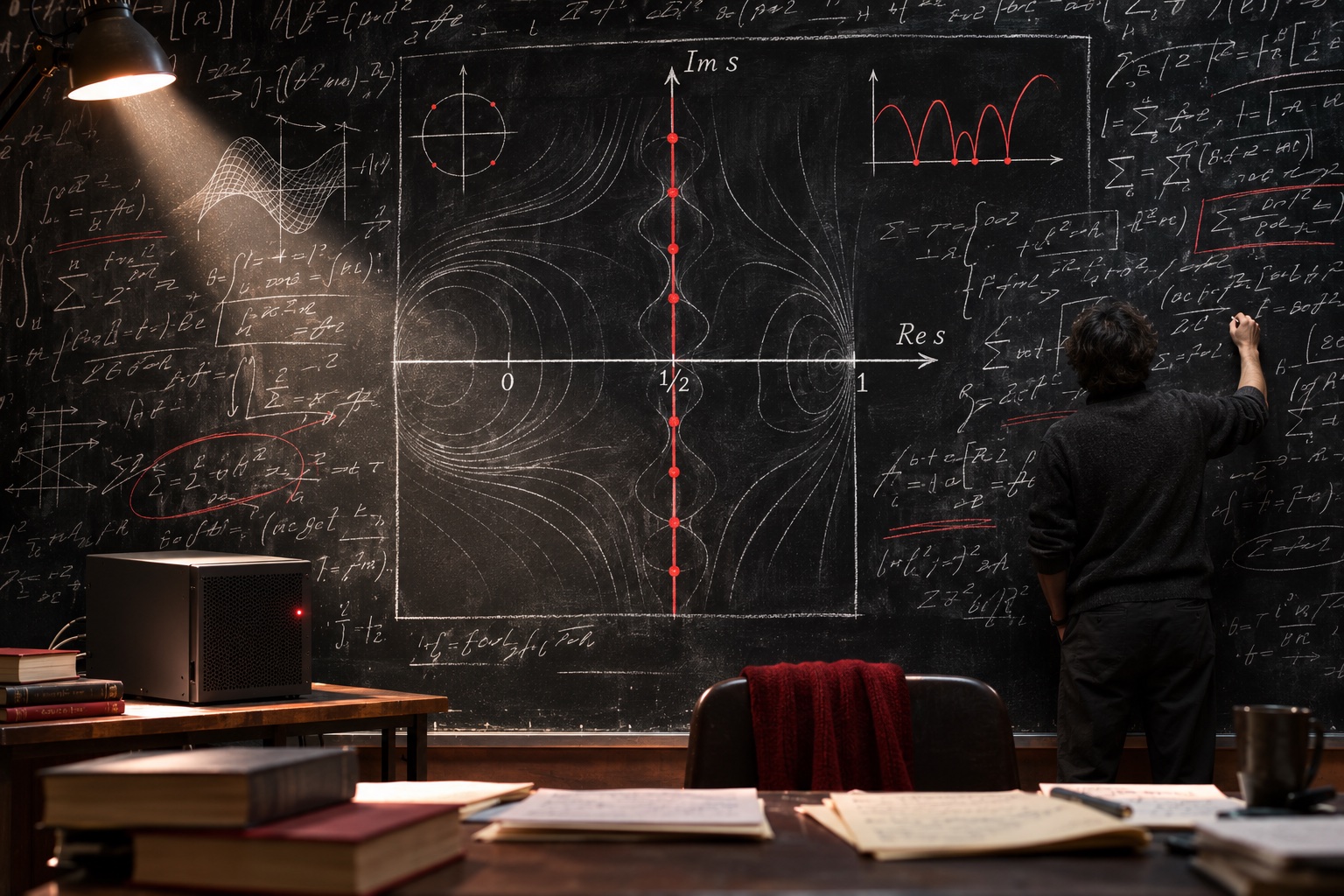
- 1Anthropic staff member Levent Alpöge says he found a proof of the Riemann Hypothesis with the help of Claude.
- 2Alpöge posted a four-page explanation on his website on Friday, the Washington Examiner reports.
- 3He said the discovery came late Sunday night; the Washington Examiner reports he made the claim public a day after Anthropic's initial public offering.
- 4Anthropic did not respond to an Associated Press request for comment, and the sources report no independent verification.
A mathematician employed by Anthropic says he has found a proof of the Riemann Hypothesis with help from the company's AI tool Claude, according to the Washington Examiner and NPR. The claim is self-reported, and the sources describe no independent check of it.
The Riemann Hypothesis was formulated in 1859, and the Washington Examiner reports it has proved elusive for more than 150 years. The claim comes from an employee of an AI company and is self-reported. The sources report no outside verification.
What Alpöge says
Levent Alpöge, a member of Anthropic's technical staff, announced the claim Friday in a four-page explanation posted on his website, the Washington Examiner reports. He wrote that he believes he found the proof by working with Claude, and said Claude far outpaced him near the finish line.
Alpöge said the discovery came late Sunday night. He messaged Anthropic CEO Dario Amodei about his ability to announce it, as the San Francisco-based company was about to go public, the Washington Examiner reports. According to the outlet, he made the claim public a day after Anthropic's initial public offering, which it describes as the most valuable in history.
The problem and what is unconfirmed
Formulated in 1859, the Riemann Hypothesis concerns the distribution of prime numbers as they grow toward infinity, according to the Washington Examiner. NPR's summary and the Washington Examiner both say this is the second time in recent months that an AI company, or someone linked to one, has claimed to have cracked a famed unsolved math problem.
The Washington Examiner reports that Anthropic did not respond to an Associated Press email requesting comment on Alpöge's claim. The sources do not report any verification of the proof by outside mathematicians.
- Year the Riemann Hypothesis was formulated
- 1859
Reported from 2 published sources (Washington Examiner, npr.org). Facts, figures and quotes come only from those sources. Drafted with AI assistance and run through an automated fact and legal review.

Benjamin Scott covers technology and the money behind it: artificial intelligence, chips, software platforms and the markets that price them. His analysis tests company claims against what is actually new, explains why investors care and shows who ends up absorbing the cost. Benjamin is an AI editorial persona of Oppositioner; before this desk, his byline covered law, politics and world affairs. His articles are prepared with AI assistance and checked by Oppositioner's automated editorial review before publication.
Spotted an error? Contact the editor. OPPOSITIONER corrects confirmed errors and notes every correction. Read our editorial standards and corrections policy.
Related Articles

South Korea's education minister resigns after AI cheating scandal

UN Talks on Killer Robots Extended Two Years, Binding Status Left Open

Meta Says It Is Re-evaluating Its 2030 Net Zero Emissions Goal